
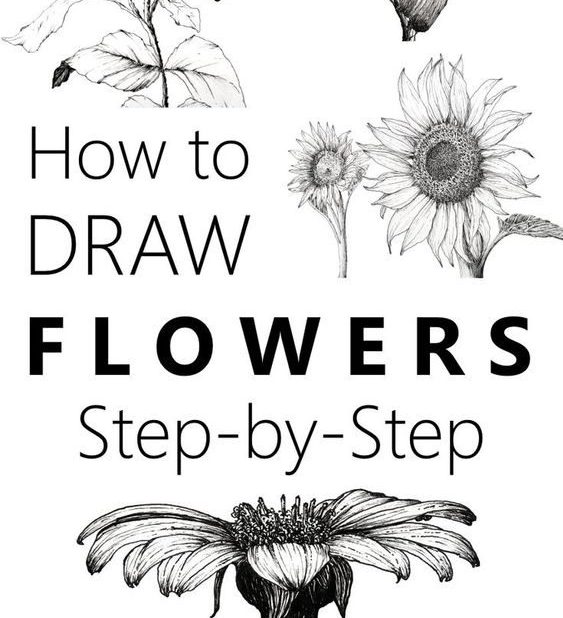
These 12 flower drawing references are useful because they show different construction problems, not just different species. A simple bloom teaches proportion, a daisy teaches repeated petals around a center, a tulip teaches silhouette, a lotus teaches layered overlap, and a rose teaches how petals turn and compress toward the middle. Click or tap any image to open the full-size reference.
Jump to: easy starting references · how to build any flower · tulip, daisy & lotus structure · layered studies · common mistakes · practice plan
If you want me to choose: start with Reference 1 for basic construction, Reference 5 for a recognizable flower with a strong silhouette, or Reference 9 if you specifically want a more realistic layered study.
Simple botanical drawing studies — References 1–4
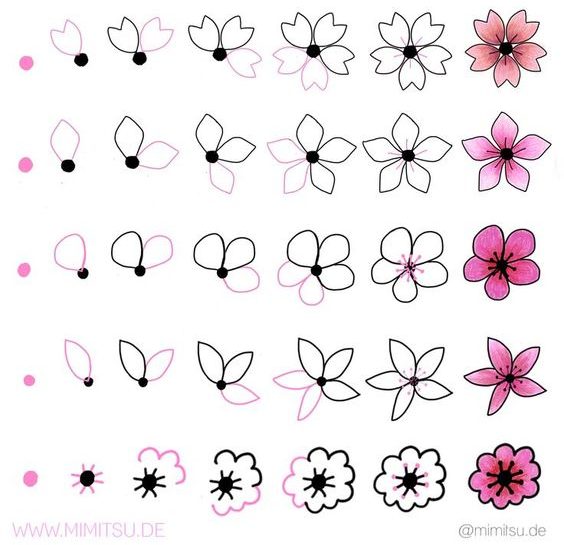
For a first attempt, mark the overall bloom size before individual petals. That keeps the flower from growing wider every time you add another edge.
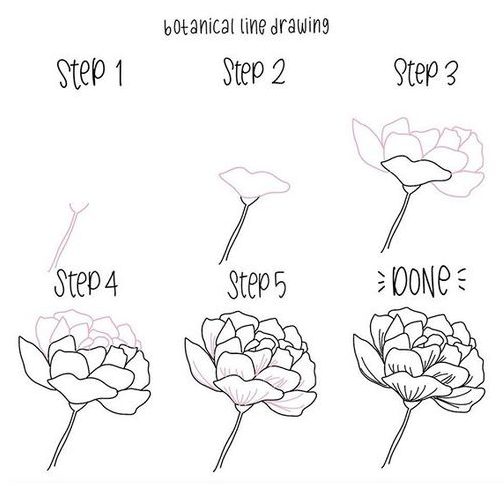
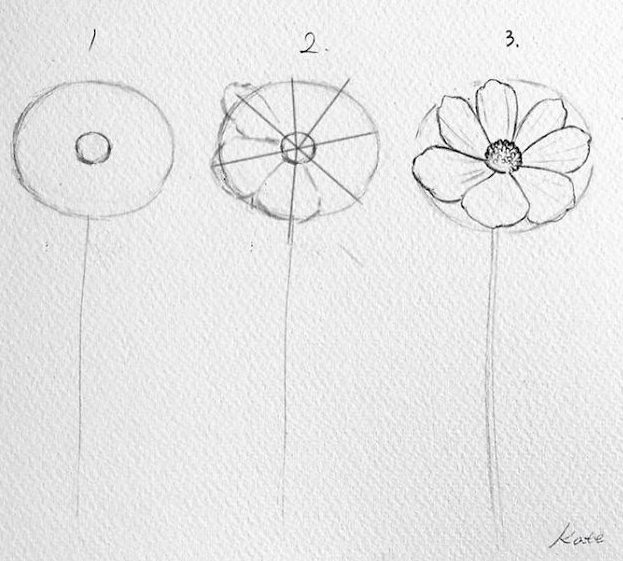
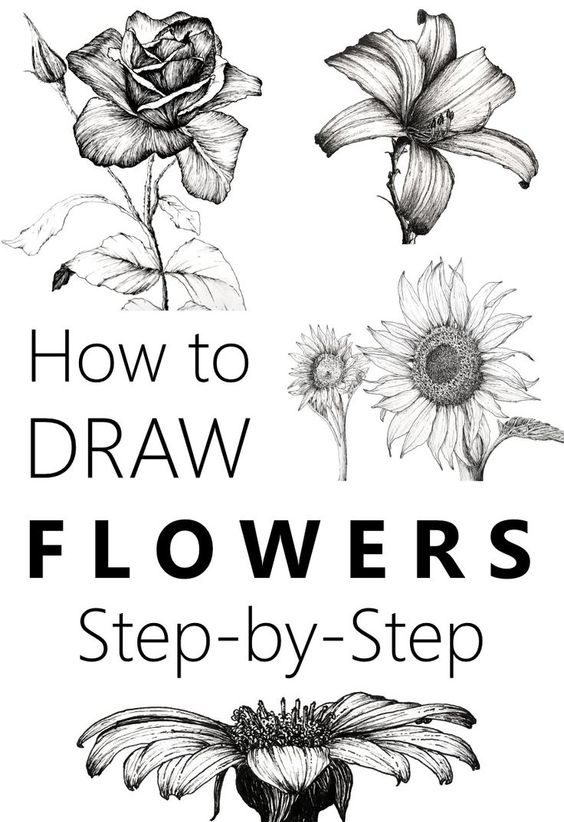
How to build almost any flower from observation
Do not begin with individual petals. That is the fastest way to lose proportion. Build the flower in layers, from the largest decision to the smallest:
- Find the main axis. Mark the direction the bloom and stem are facing. A flower tilted toward you needs a different petal shape from one seen side-on.
- Draw the bloom envelope. Lightly mark the overall width and height as an oval, circle or cup-like mass. This gives every later petal a boundary.
- Locate the center. The center is not always in the geometric middle. On a tilted flower it shifts, and that shift tells you which petals will look shorter because of perspective.
- Place petal groups before petal edges. Think front, side and back petals rather than drawing twelve separate shapes with equal importance.
- Show overlap deliberately. Decide which petal sits in front. Let one edge disappear behind another instead of outlining everything continuously.
- Add the stem and leaves last. Make sure they actually attach to the flower structure rather than looking pasted on beneath it.
This sequence works because it protects the big relationships. If the bloom is too wide, the center is misplaced or the stem enters at the wrong angle, extra veins and shading will not rescue it.
Petals are surfaces, not symbols
A beginner often draws every petal as the same pointed oval. Real petals bend, twist, overlap and turn toward or away from the viewer. When a petal faces you, you see more of its surface. When it turns sideways, it gets visually narrower. When it curls back, the outer contour may stay simple while an interior fold line explains the change of plane.
Use fewer interior lines than you think you need. One well-placed fold can describe a petal better than five decorative veins. On simple flowers, the outer silhouette and overlaps do most of the work.
Stems and leaves should support the bloom
Draw stems with a slight directional rhythm instead of a perfectly straight ruler line unless the reference genuinely calls for it. Leaves should branch from believable attachment points and follow the same perspective as the stem. A leaf seen edge-on becomes much thinner than one facing you.
For botanical accuracy, look at the actual leaf shape and vein direction of the species you are drawing. Reusing one generic leaf shape under every flower is one of the quickest ways to make different species feel interchangeable.
Tulips, daisies, black-eyed Susans and lotus — References 5–8
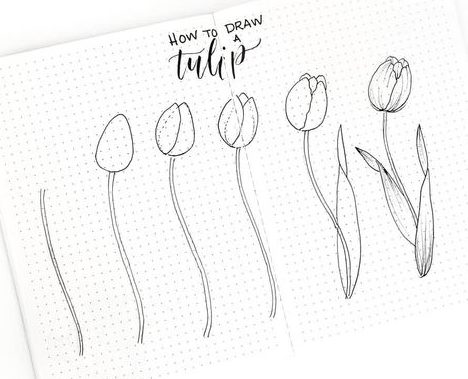
Tulip: think cup before petals. The outside silhouette carries most of the identity. Establish the width, taper and opening at the top first; then divide that cup into a small number of overlapping petals. If you draw separate petals first, the tulip often becomes too wide and loses its compact form.
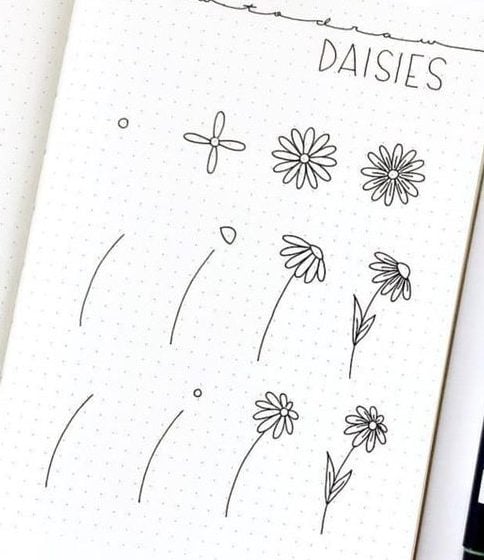
Daisy: draw the center disk first, then place the petals around it as a rhythm rather than a fence of identical spokes. Vary length and angle slightly. Petals on the far side can look shorter or narrower, especially if the flower is tilted.
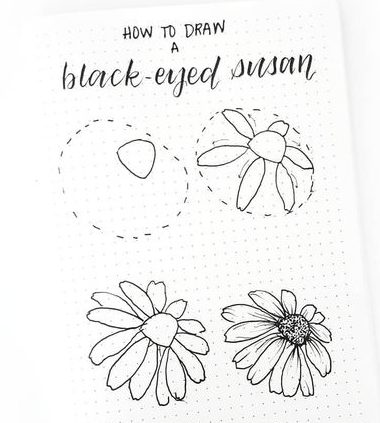
Black-eyed Susan: the dark center is not just decoration; it is a separate form sitting above the petal ring. Give it volume. A slightly domed center with petals emerging from behind it reads much more convincingly than a flat dark circle pasted over the middle.
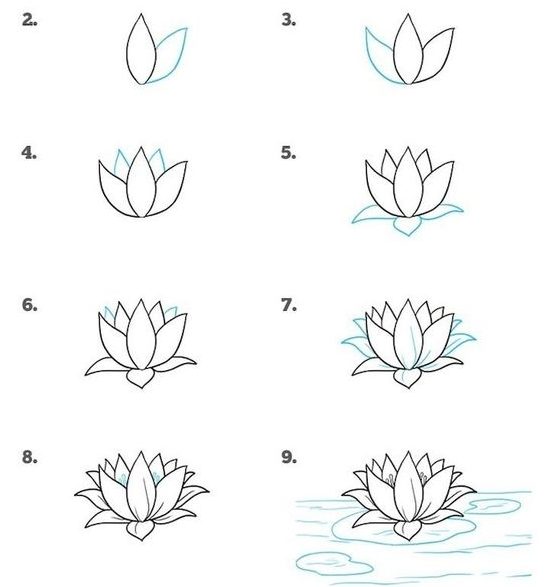
Lotus: think in stacked rings. Place the front petals first, then let the next layer rise behind them. Avoid drawing every petal from the same baseline. The sense of depth comes from staggered attachment points and clear front-to-back overlap.
How perspective changes a flower
A flower facing you tends to look more circular. Tilt it away and the bloom compresses into an ellipse; the far petals become shorter, and the center shifts toward the far edge. That single change explains many drawings that feel “almost right” but strangely flat.
Before adding detail, compare three things: the width-to-height ratio of the bloom, where the center sits inside that shape, and how much of the far-side petals are visible. If those three agree with the reference, the flower usually reads correctly even with very little shading.
Layered and more realistic flower studies — References 9–12
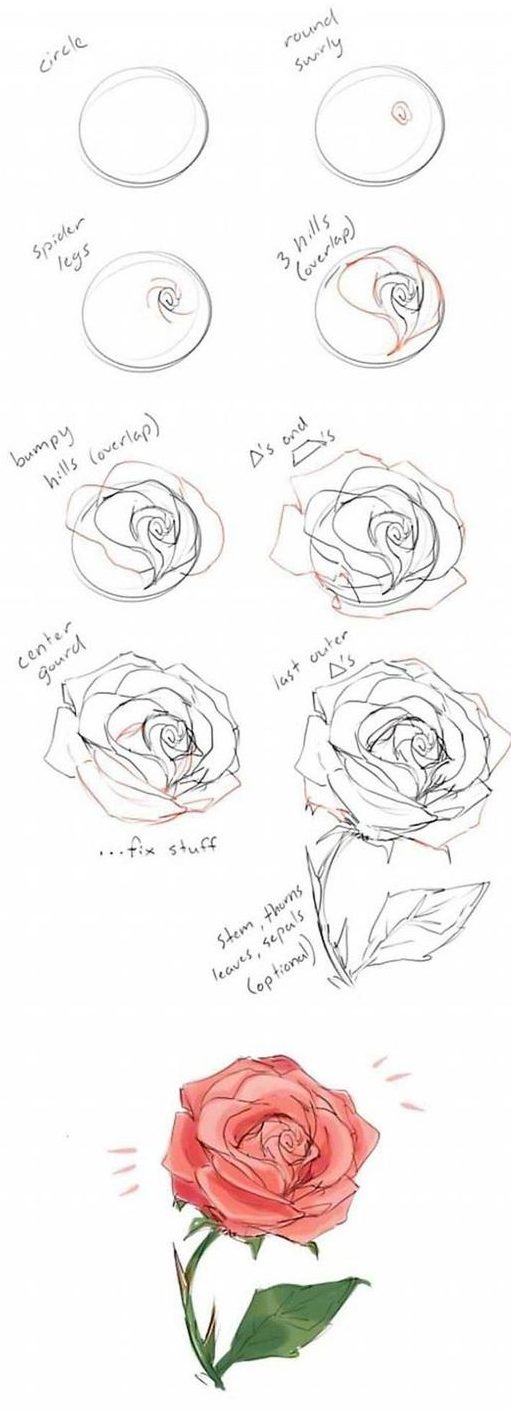
Rose: do not treat the center as a spiral icon and then surround it with repeated loops. Think of petals wrapping around a compact core. The inner petals are tighter and more upright; the outer petals open, flatten and turn outward. Build that change gradually.
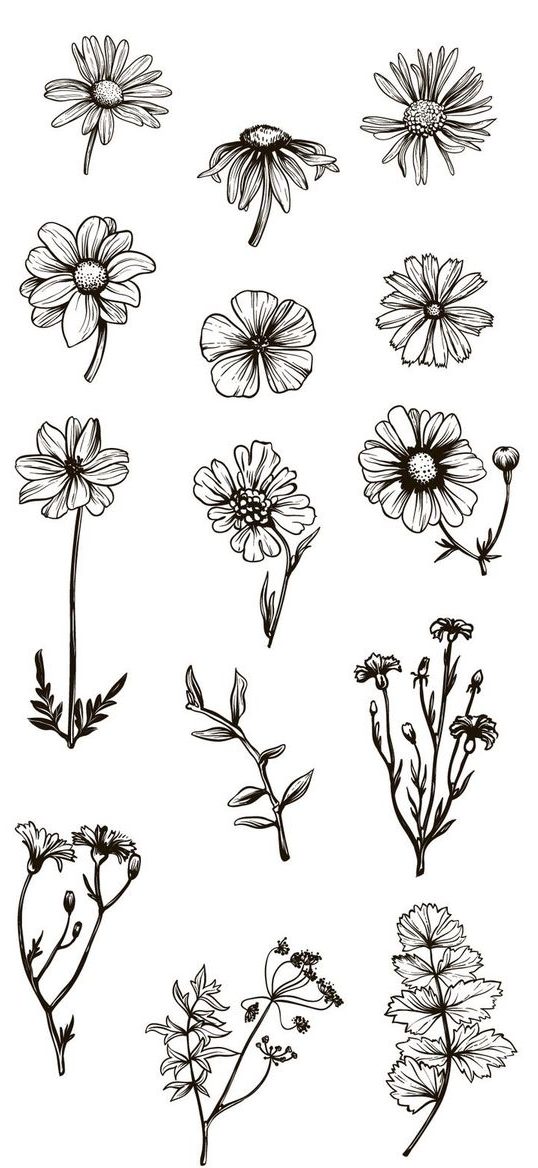
On a dense flower, look for the big directional sweep before the small petal edges. A cluster may fan outward, cup upward or droop to one side. If that larger movement is clear, you can simplify many small petals and the drawing will still feel convincing.
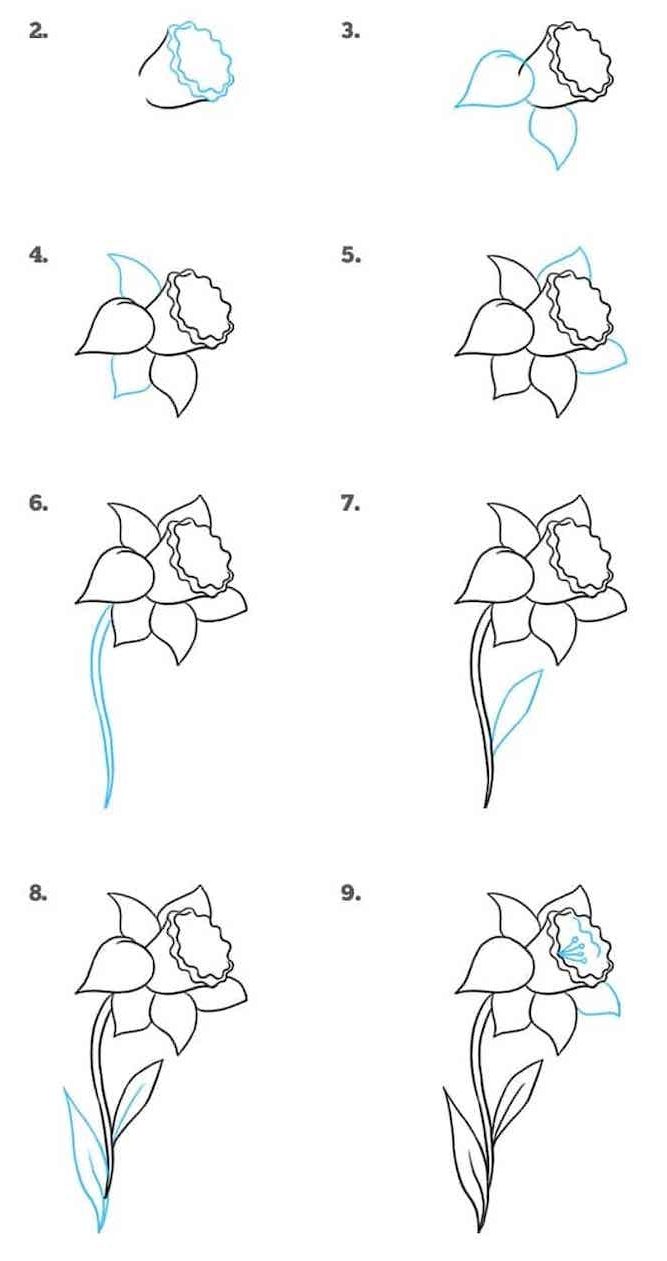
When you refine a step-by-step study, do not give every edge equal weight. The front rim of a petal may deserve a clearer line; an edge turning into light can be softer or partly lost. That change in edge strength is one of the easiest ways to make a pencil flower feel less cut out.

A botanical study asks for more than a pretty bloom. Pay attention to how the stem branches, where leaves attach, whether leaf pairs alternate or oppose each other, and how the flower head connects to the stem. Those structural details make a plant feel observed rather than invented from a symbol library.
How to shade flower petals without making them look dirty
Most petals are lighter than beginners expect. If you cover the whole flower with middle-gray graphite, you lose the delicate value range that makes petals feel thin and luminous. Start by keeping the paper white in the lightest areas.
- Darken contact shadows first. The narrow pocket where one petal tucks under another usually deserves more graphite than the broad surface of either petal.
- Shade the turn, not the outline. Let tone gradually increase as a petal curves away from the light instead of tracing every petal with a dark border.
- Separate cast shadow from local color. A dark mark caused by another petal sitting above it should have a clearer edge than a gentle form shadow across a curved surface.
- Keep texture subordinate. Veins and small wrinkles are finishing information. If they become darker than the main overlaps, the flower starts looking patterned instead of three-dimensional.
If you are unsure where to shade, squint at the reference. The tiny details disappear and the main light-dark pattern becomes easier to see.
Why flower drawings go wrong
- The flower keeps getting bigger as you add petals. Draw the outer bloom envelope first and keep checking against it.
- Every petal looks identical. Vary width, length, tilt and how much of each petal is hidden. Repetition should have rhythm, not cloning.
- The center looks pasted on. Treat it as part of the form. On daisies and black-eyed Susans, petals pass behind the center disk rather than simply touching its outline.
- The flower looks flat. Check the bloom ellipse, center placement and overlap order before adding more shading.
- The rose looks like a spiral. Replace symbolic loops with overlapping petal planes that gradually open as they move outward.
- The leaves look unrelated to the species. Observe attachment, proportion, margin shape and vein direction instead of defaulting to generic pointed leaves.
- The drawing gets muddy during shading. Save the darkest graphite for narrow overlap pockets and cast shadows. Let broad petal planes stay lighter.
A 20-minute flower drawing practice that actually transfers
- Minutes 1–3 — gesture and envelope: mark the stem direction, bloom width and height, and center position. No petals yet.
- Minutes 4–8 — petal groups: place front, side and back petal masses. Use only enough lines to explain overlap.
- Minutes 9–12 — species clues: add the features that make it a tulip, daisy, lotus or rose rather than a generic flower.
- Minutes 13–17 — three values: keep paper white for light, add a middle tone for turning forms, and reserve dark graphite for overlap pockets.
- Minutes 18–20 — edit: erase or soften any line that is louder than the form it describes.
Then draw the same flower once more at half the size without copying every detail. That second version tells you whether you understood the structure or only followed the reference line by line.
How to draw a bouquet without making it look like a row of stickers
Start with the bouquet as one large silhouette. Place three or four main bloom masses at different heights and angles before drawing a single petal. Let some flowers overlap others, and leave small negative spaces between stems so the arrangement can breathe.
Vary scale as well as height. A flower angled toward you can appear larger; one turning away can compress. The stems should converge toward believable gathering points rather than dropping straight down in parallel lines.
Only after the bouquet works as a group should you develop individual petals. If every flower is finished separately before the next one begins, the result often feels assembled rather than grown.
Choose the right reference for what you want to learn
Use Reference 1 when you want the basic sequence. Use Reference 5 to study silhouette, Reference 6 for repeated petal rhythm, Reference 8 for layered overlap, and Reference 9 when you are ready to deal with a dense center and changing petal planes.
Where to go next
If roses are the part you want to study properly, the rose drawing guide goes much deeper into that one structure. To strip flower shapes down to their essential line rhythm, try the one-line drawing exercises. For broader beginner practice away from botanicals, use the easy things to draw collection.
Flower drawing questions
What is the easiest flower to draw for a beginner?
A simple daisy-like bloom is a good starting point because the construction is easy to understand: center disk, petal ring, stem and leaves. The challenge is keeping the petals varied enough that they do not look mechanical.
Should I draw petals one at a time?
Not at the beginning. Establish the overall bloom, center and main petal groups first. Individual edges make more sense once the larger structure is fixed.
How do I make petals look soft instead of outlined?
Reduce line weight where the petal turns into light and let shading describe some edges instead of enclosing every petal with a dark contour.
Why does my flower look flat even after I shade it?
The problem is often structural rather than tonal. Recheck the bloom ellipse, center placement and which petals overlap. Shading cannot create depth if the front-to-back order is unclear.
Do I need to know flower anatomy?
You do not need botanical terminology to begin, but careful observation matters. Notice how petals attach, how the center is built, where leaves join the stem and how the plant branches. Those facts are more useful than memorizing a generic flower formula.
Reference-use note
This is a legacy drawing gallery, and original artist attribution or reuse licensing is not documented for every reference. Use the images for study and drawing practice; do not assume the source artwork itself is cleared for commercial republication.


This the Best Showing How to MAke flower Steps Has help me to prove on my flowers…..
Thank you
l have enjoyed drawing your flowers and l feel so confident at how my drawing has improved so much since l have had a go at your steps which has speeded me up no end………. thank you lots
loved them