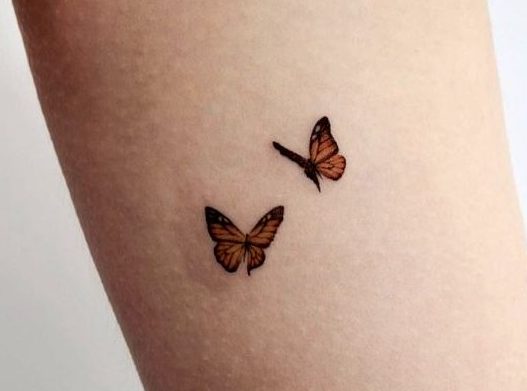
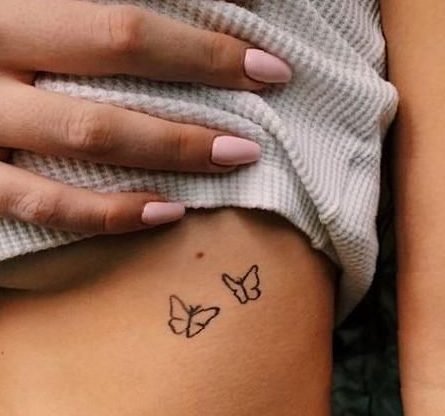
Small butterfly tattoos work best when the design stays readable at a small scale. Before choosing one, look past the overall silhouette: check how much empty space sits between the wings, how fine the antennae are, and whether the inner wing details will still be clear when the tattoo is only a few centimeters wide. The eight references below show different placements and levels of detail so you can compare what suits your idea.
What makes a small butterfly tattoo work?
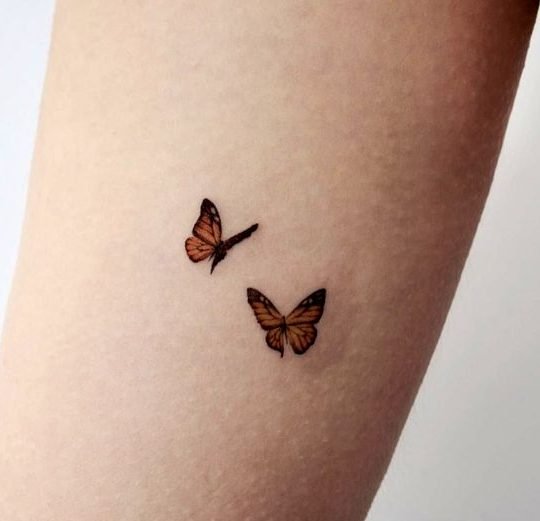
A butterfly gives you an instantly recognizable shape, but mini tattoos leave little room for error. A strong small design usually has a clean outer contour, enough negative space between major lines, and only a few interior marks. If every vein from a real butterfly wing is copied into a tiny tattoo, those lines can visually crowd together as the tattoo settles and ages.
When comparing references, use this quick check:
- Silhouette: Can you recognize the butterfly from arm’s length?
- Line spacing: Are the smallest gaps large enough to remain distinct?
- Symmetry: Decide whether you want balanced wings or a deliberately hand-drawn, asymmetric look.
- Placement: Flat areas allow a different composition from curved or high-movement areas such as the wrist.
- Detail: Ask which lines are essential and which can be removed without losing the butterfly.
Butterfly tattoo meaning
Butterflies are commonly associated with transformation because of metamorphosis from caterpillar to chrysalis to winged adult. People also choose them to represent change, freedom, a new phase of life, or simply because they like the form. Meanings are personal rather than fixed, so you do not need to attach symbolism to the design if your reason is purely visual.
If symbolism matters to you, write down the idea in one sentence before discussing the tattoo with an artist. That makes it easier to decide whether a delicate outline, a darker traditional treatment, or a more naturalistic butterfly actually fits the feeling you want.
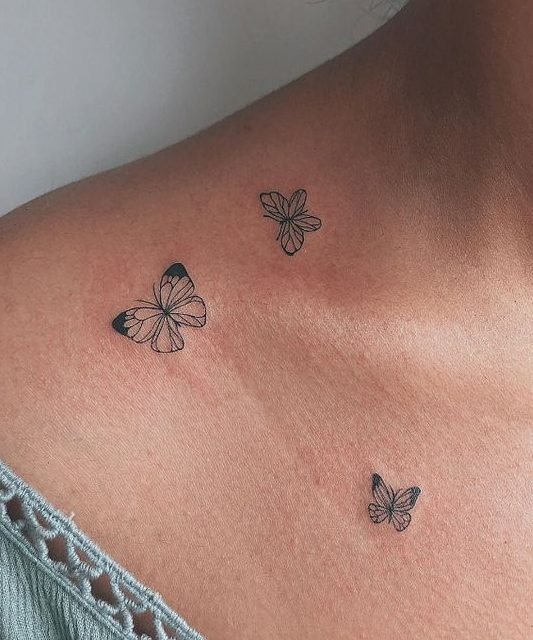
Choose a style that survives the size
Fine-line and minimalist
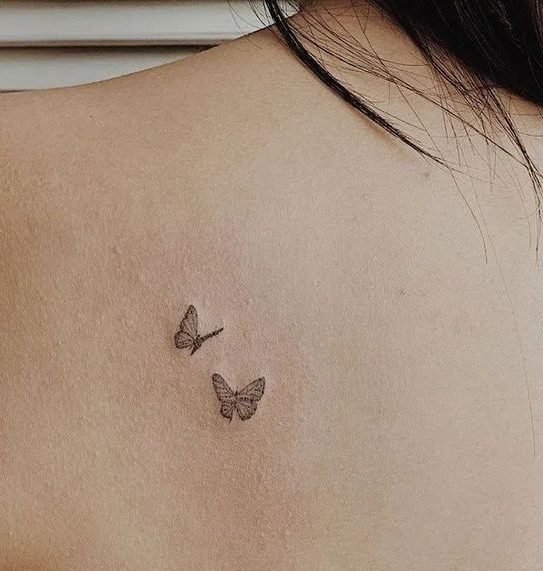
For a very small butterfly, start with the outline and add interior marks only where they help define the wings. A design that looks slightly sparse on a phone screen can translate more clearly to skin than one packed with tiny decorative lines. Ask your tattoo artist what minimum spacing and line weight they recommend for the exact size and placement you want.
Traditional and bolder outlines
A traditional-inspired butterfly can use a heavier contour, simplified wing sections, and selective shading. This approach is useful when you want the tattoo to read clearly from a distance. If you like an elaborate reference, ask the artist to simplify it rather than shrinking every detail proportionally.
Realistic butterfly
Realism needs more room for wing pattern, value changes, and color transitions. If the reference depends on tiny scales or numerous veins, increasing the final tattoo size may produce a better result than forcing the same information into a miniature design.
Placement: compare the design on your body, not just on a screen
Behind-the-ear, shoulder, chest, forearm, and wrist placements all change how a butterfly reads. Print or sketch the design at the intended size and hold it against the area in a mirror. Then try it slightly larger and smaller. This simple test reveals whether the wings feel cramped, whether the orientation follows the body naturally, and whether you actually like how visible the tattoo is in everyday clothing.
For a first tattoo, also discuss healing, sun exposure, friction, and how that particular placement tends to hold fine detail with a professional tattoo artist. Those practical constraints should influence the final drawing.
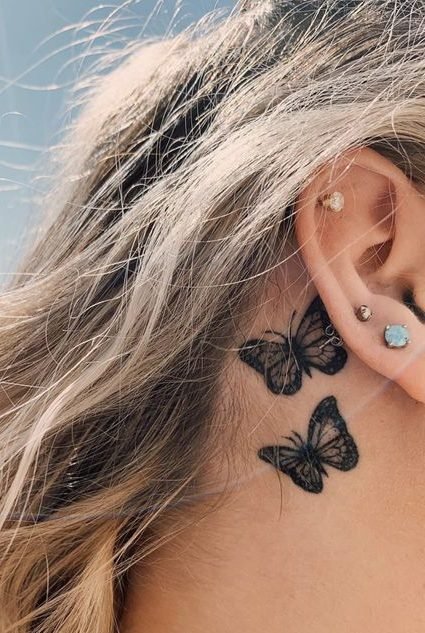
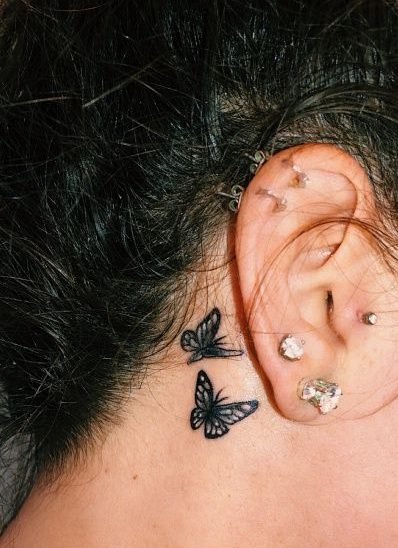
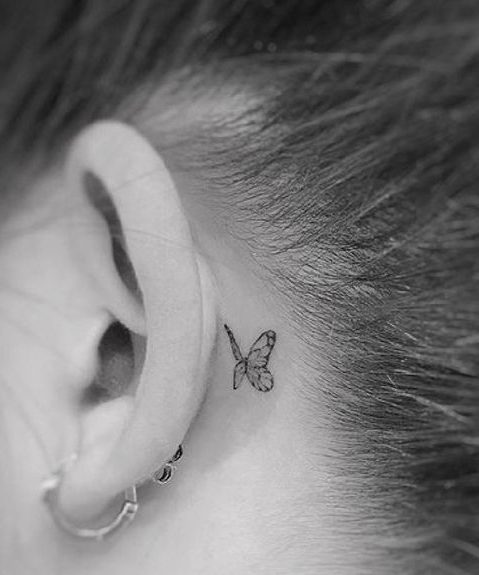
How to use these references before your appointment
Do not ask an artist to copy another person’s tattoo line for line. Instead, save two or three references and identify what you like in each: wing shape, line weight, orientation, amount of shading, or placement. Bring those preferences to the consultation and let the artist redraw them into an original design that fits your anatomy and the size you have chosen.
Small butterfly tattoo FAQ
How small can a butterfly tattoo be?
There is no universal minimum because the answer depends on the number of lines, the artist’s technique, placement, and the design itself. If reducing the size makes the wing sections merge visually, simplify the design or make it larger.
Should both wings be perfectly symmetrical?
Not necessarily. Symmetry gives a clean emblem-like look, while slight differences can make the butterfly feel more organic. What matters is that asymmetry looks intentional rather than accidental.
What should I check in a tiny tattoo stencil?
Look at it both close up and from normal viewing distance. Check the narrowest gaps, the antennae, the center body, and any intersections inside the wings. If the design already feels crowded as a stencil, ask what can be simplified.
One extra small tattoo reference
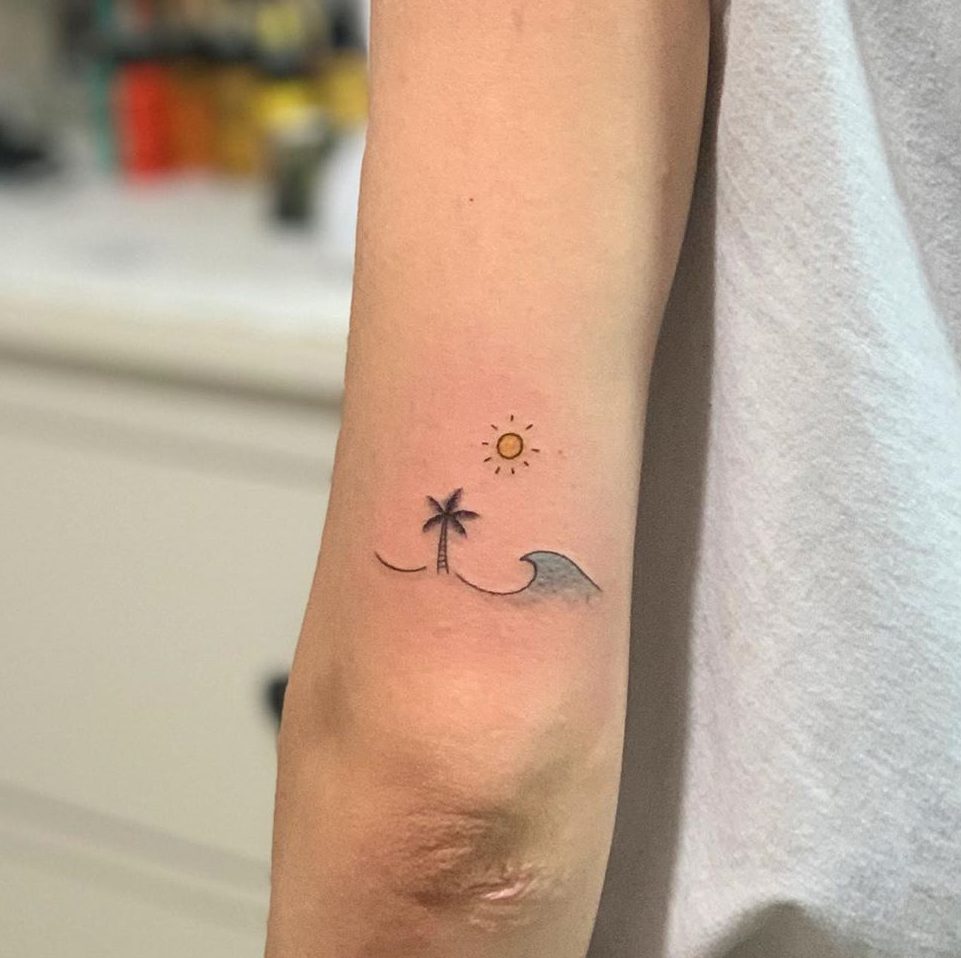
The final image below is not a butterfly. It is retained from the original collection as an extra example of how a compact wrist tattoo occupies a small area; use it for scale and placement inspiration rather than butterfly design details.